
“We believe in the communion of all the faithful of Christ, those who are pilgrims on earth, the dead who are being purified, and the blessed in heaven, all together forming one Church; and we believe that in this communion, the merciful love of God and his saints is always attentive to our prayers.”
Article 962 of the Catechism of the Catholic Church
Dedication
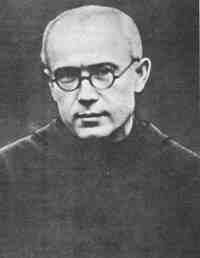

It was quite a challenge to select a candidate for the dedication of OC when all of the candidates under consideration were already Saints in heaven! But we persevered and finally selected someone who was very close to our time and culture, and of course, like all of the saints, experienced life in harmony with the values extolled in our Mission Statement.
After much consideration, we chose St. Maximilian Kolbe. His biography is well known, and one can easily review the details by accessing the internet search engines and by reading his life story. Yet, there were several events during his life, for the purposes of this dedication which especially caught our attention and which we would like to highlight.
First of all, he was born Raymond Kolbe on January 8, 1894 of Polish- German ancestry in Poland and died on August 14, 1941 in the Auschwitz concentration camp of Nazi-occupied Poland. During his 47 years, he became a priest in the order of the Conventual Franciscans on 28 April 1918 in Rome, and added the name of Maria to his religious name, Maximilian, thereby showing his devotion to Our Blessed Mother.
Earlier, while a student in Rome, and in response to vehement demonstrations against Popes St. Pius X and Benedict XV, he organized the Militia Immaculata, or Army of Mary, to work for conversion of sinners and enemies of the Catholic Church, through the intercession of the Virgin Mary.
The Immaculata Friars under the direction of St. Maximilian utilized the most modern printing and administrative techniques in publishing catechetical and devotional tracts, a daily newspaper with a circulation of 230,000 and a monthly magazine with a circulation of over one million. They also used radio to spread the Catholic faith and to speak out against the atrocities of the Nazi regime. He is the only canonized saint to have held an amateur radio license, with the call sign SP3RN.
After the outbreak of World War 2 on 1 September 1939, starting with the invasion of Poland by Nazi Germany, St. Maximilian provided shelter to refugees from Greater Poland, including 2,000 Jews whom he hid from Nazi persecution in his friary in Niepokalanow. On 17 February 1941, he was arrested by the German Gestapo and imprisoned in the Pawiak prison, near Warsaw. On 28 May, he was transferred to Auschwitz. It was there, at the end of July, that he offered to take the place of another prisoner who was Jewish in the starvation bunker, a form of punishment meted out by the Nazis as a means for discouraging escape attempts. Eventually, after being in the bunker for 2 weeks, he was injected with carbolic acid and died. His remains were cremated on 15 August, the feast day of the Assumption of the Blessed Virgin Mary. He was canonized a Saint on 10 October 1982 in St. Peter’s Basilica, Vatican City by Pope John Paul the 2, declaring him a martyr.
St. Maximilian is considered to be a patron saint for such things as drug addiction, families, imprisoned people, journalists, political prisoners, prisoners in general, the pro-life movement, and amateur radio, and has been honored in both the Lutheran and Anglican Churches.
In dedicating OC to St. Maximilian, we realize that we have much to live up to in following his example, both as individuals and as an organization. For we, too, live in difficult times where the Culture of Death in all of its forms is active and intimidating in countries throughout the world. It is our intention to be like St. Maximilian and so many other great saints throughout history by standing fast for those same Catholic values that they supported, even in the face of the trials and persecutions of our time. For this, we pray to all in heaven for their prayerful intercession.
“In the meantime, the whole life of the Church benefits from the mysterious and powerful help of angels.”
Article 334 of the Catechism of the Catholic Church
Oremus Communications (OC) is about the expression and promotion of Roman Catholic values such as prayer, sacrifice, repentance, the Culture of Life, faithful and complete adherence to the appropriate levels of the Magisterium of the Roman Catholic Church, unity under the Bishops, ecumenical dialogue, and reliance upon the intercession of the Saints and Angels, especially our patron, St. Maximilian Kolbe. Pursuit of these values and others is vital in the attainment of some measure of happiness here on earth and eternal happiness with Our Father in heaven whose name is hallowed and whose love for all of us is unbounded.

OC is focused on sending prayers of all kinds through live real time streaming on the internet to the Communion of Saints in heaven, including the Father, The Son, and Holy Spirit, Our Blessed Mother, the Angels and all the Saints. And in the case of intercessory prayer, we pray for their heavenly assistance in all of our needs and in the needs of those in Purgatory. The picture on the home page reflects this reality by depicting all of those who belong to the mystical Body of Christ, integrated as one.
The emphasis on prayer, sacrifice, and repentance are fundamental and have been mentioned in the formation of the faithful since the beginning of the church, two thousand years ago, with Christ, Himself, setting the example.
Sacrifice can be of many kinds, but they all have one thing in common, a denial of self for the sake of another. Repentance has also been part of the equation for that ultimate prize of eternal life. Think no further than the time of John, the Baptist, and the prophets in the Old Testament and we see very early the importance of repentance.
The Culture of Life is a relatively new term invented by Pope John Paul 2 in a visit to the United States in 1993 during a World Youth Day tour. It encompasses a variety of issues including for example: opposition to abortion, sterilization, human cloning, artificial contraception, human embryonic stem cell and fetal research, euthanasia, murder, suicide, unjust war, excessive selfishness; and the promotion of agape love and charity, matrimony, maternity, fatherhood, life, chastity, fidelity and virtue.
Faithful and complete adherence to the Magisterium of the Catholic Church calls for acceptance of the teaching authority of the Church on a number of levels such as when the Pope speaks “ex cathedra”, or when the Bishops in union with the Pope define a doctrine at a General Council, and so on. The point to remember here is that faithful Catholics accept all of these teachings and not just the ones with which they happen to agree. Case in point is the encyclical “Humanae Vitae” where Pope Paul , the sixth, in July of 1968, among other things, reaffirmed Church teaching by continueing to ban artificial contraception as a form of birth control. The encyclical met with much criticism but those faithful to the Church Magisterium did not blink, but accepted the teaching in its entirety and acted accordingly.
Unity in the church includes acceptance of the Bishops in their role as successors to the Apostles. (re: article 862 of the Catechism of the Catholic Church “….The Bishops have by divine institution taken the place of the Apostles as pastors of the Church, in such wise that whoever listens to them is listening to Christ and whoever despises them despises Christ and him who sent Christ.”) This translates in part into the mandate for meaningful attention by the faithful to the issues and policies raised by the Bishops in their collective gatherings. For example, the United States Catholic Conference of Bishops (USCCB) calls for action on the part of faithful Catholics in a number of areas such as the defense of religious liberty, the practice of faithful citizenship in accordance with an informed conscience, the promotion of marriage and the family, the embrace of cultural diversity especially in the area of evangelization, and the promotion of human life and dignity ( this area opens the door to a number of other issues including social and international justice and peace, domestic social development, meaningful immigration reform, but to name a few).
In speaking of the Holy Mother of God, we on earth have been blessed with her presence on a number of occasions in the form of church approved apparitions. Many times, she called for prayer, sacrifice and repentance , along with faithful obedience to the teachings of the church. By doing so, she gave confirmation to what we already knew, that by pursuit of these values, we are empowered to help save souls from hell and to help bring about world peace. ( i.e. In the six apparitions at Fatima in 1917, she repeatedly called for the daily recitation of the rosary, the regular practice of the First Saturday Devotion as well as a life of sacrifice.)
Ecumenical dialogue began in earnest with Pope John, the 23rd and the Second Vatican Council who emphasized the importance of dialogue with separated brothers and sisters and with separated churches and church communities. This was followed by more meaningful efforts under Popes Paul 6 and John Paul 2. The idea of reconciliation and peace as part of the Ecumenical Renewal also reveals the fundamental value of forgiveness, so basic to the Christian life. This is very well summed up in an article, “ Reflections by Cardinal Walter Kasper” on the Vatican website, stating under the Ecclesiological Foundation section “……that the churches see themselves no longer as enemies or rivals: no longer do they live in indifference to each other. There is a re-discovered Christian brotherhood involving all on a common pilgrimage to the re-establishment of the full visible unity of the Church through dialogue.”
Every generation has had those gifted people who responded to the call for proclaiming and promoting the Gospel and its attached values, by blending their own unique talents, available resources and technologies of the time with those very values into a variety of enduring and creative expressions. Witness the Renaissance and the creative energies of the great artists and sculptors like Michelangelo, Raphael, Da Vinci, Fra Angelico, et al., who took the fundamental Catholic values and gave them expression in such great works of art and religious devotion that they are still revered even to this day.
We live in the time of the Information Age where the key instrument is the computer and the World Wide Web. OC wants to follow in the footsteps of our predecessors and express and promote those same Catholic values in our programming, making use of the resources and technology of our time. OC is a collaborative effort between its leaders and its devoted listeners. Together, we ,too, like those before us, can make a difference with eternal consequences! OREMUS.
WHO WE ARE
Oremus Communications (OC) is a Roman Catholic Communication service utilizing modern web streaming technology in accordance with guidelines established by the Pontifical Council for Social Communications concerning the use of the internet.
The service is organized as an LLC (Limited Liability Company) with all personnel acting as volunteers in a variety of capacities such as Program Director, Communications Director, Station Manager, Host, and so on, all dedicated to the implementation of the Mission Statement.
The different people occupying these positions come from all walks of life including the young and the old, the religious and lay, professional and the non-professional, employed and unemployed, etc. But they all have one thing in common. They all have a passion to carry out the goals of the Mission Statement in the context of our time in history with all of its challenges and opportunities.
We believe strongly in the mission statement. We remember Genesis 18:16-19:29 when Abraham bargained with Yahweh for the safety of Sodom and Gomorrah with all of their inhabitants if only 50 good men could be found and then only 10. The Lord was ready to accept only 10. And so we are confident that the Lord will look favorably on the prayers and sacrifices of the OC community regardless of numbers.
Like those who have gone before us, it is our passion and committment that we make to our Catholic values and traditions (hoping to make a spiritual difference) that really matters.
LEGION OF MARY
Legion of Mary Immaculate Conception Praesidium Divine Mercy Chaplet Program
Every Friday at 3:00 PM Eastern Time. Click here to listen on Legion of Mary Wilmington Curia YouTube Channel. You can also listen to their archived programs when they used to broadcast from Oremus Communications by scrolling down and clicking on the date of the program.
Our Mission Statement
In keeping with our Baptismal duty to “go out and preach the Gospel to the world”, the Legion of Mary uses all means of communication available. Our goal is to help its members and all those whom we meet in their journey of sanctification, by sharing God, through His Mother, and giving glory to God.
TRIBUTE TO THE FOUNDER OF OREMUS COMMUNICATIONS
Oremus CommunicaƟons was founded on the Principle of making a spiritual difference in the world through the prayers, values,
virtues and teachings of The Catholic Church and so we have since our inception.
We here at Oremus Communications sadly announce the passing of our founder Anthony J. McGinley on Holy Thursday, April 9,
2020. Tony, as he was affectionately called was a loving son of the Blessed Mother. He was dedicated to promoƟng all messages
of Fatima ‐ the praying of the Holy Rosary and a staunch pro‐life leader and warrior from the very beginning of the pro‐life
movement in 1973. Tony was a patriot and soldier in the USA army and loved God, country, family and friends. Mostly, he loved
his Lord and Savior Jesus Christ and the Sacraments of The Catholic Church and The Blessed Mother. He will be greatly missed and
irreplaceable! May the light of the Lord shine upon him and grant him peace and may he forever be our guardian intercessor in and
for the mission he started.
LINKS
Archdiocese of Philadelphia, PA
Collage of Photos from George Isajiw
Joyful Films 2022 Lenten Series inspiring daily short videos
The world-famous International Pilgrim Virgin Statue of Our Lady of Fatima Tour
Knights of Columbus | Catholic Fraternal Organization
Lay Dominicans – Eastern Province of Lay Dominicans
National Shrine of the Immaculate Conception
Pennsylvania Catholic Conference
St. Raymond Nonnatus Foundation, Freedom, Faith & Family
Together We Ken! An Oremus Communication Film
United States Conference of Catholic Bishops
FATIMA CHRONICLES
FATIMA CHRONICLES
Autobiographical account of a visit to Fatima, Portugal
in October 2004 by our own Tony McGinley, Program Director of the OCFRP.
Click Here to print Fatima Chronicles
As trips go, five days did not seem to be enough time to experience Fatima. But at the end,
I was amazed at how much our small group of ten was able to accomplish on a Blue Army Pilgrimage
to FATIMA this past October 14 – 19, 2004.
From the moment we arrived at the Lisbon Airport at 6:00 A.M. on Sunday morning, Oct. 10, we were off to the races.
First, we took an early morning ride on our comfortable mini-bus through the historical areas
of downtown Lisbon. Our tour guide, Manuela, was most knowledgeable about all facets of
Portuguese society and culture, both past and present. She pointed out many of the historical,
architectural, and geographical features of downtown Lisbon such as the Tagus River running through
the heart of Lisbon out to the Atlantic Ocean and the historical monuments depicting many of
Portugal’s naval and maritime greats. Her expertise made me remember much I had learned about the
Age of Discovery (15th & 16th centuries) in school, and the great role played by Prince Henry, the
Navigator, and other notables of Portuguese history.
Next on the agenda was a Mass in the Cathedral of St. Anthony, also in Lisbon. The
architecture and art work was rich enough to make any student of medieval culture want to “go back
to the books.” By this time, we were tired, but onward we went, on to Santarem, the home of
the church containing the Eucharistic Miracle called “The Bleeding Host.”
Finally, at lunchtime, we arrived in Fatima and departed our bus at Domis Pacis – the Blue
Army hotel. After registration, a quick meal and a short rest, some of us made our way to the
Basilica and Capelinha (little Chapel), or Chapel of Apparitions where Our Blessed Mother
appeared to Lucia, Jacinta, and Francisco on the 13th of each month from May thru October of the
year 1917 (all except August 13).
What a thrill! I had always wanted to see this holy place ever since my Uncle Bob (d.o.b
10/13/1916) taught me about Fatima when I was just a boy. And finally, here I was – right where it all
happened. The area is quite large, measuring approximately 500′ by 900′ and can hold more than
100,000 pilgrims. But for me, the main focus was the chapel and the statue of Our Blessed Mother
marking her appearance on the five occasions mentioned above.
Before heading back to the hotel for dinner and a good night’s rest, I made a quick visit inside
the Basilica, and was able to see the grave markers for Jacinta and Francisco. It was fortunate that I
did so, since as it turned out, I did not get another chance for the remainder of the trip.
On the next morning, we went as a group back to the Sanctuary area where Manuela was able
to give us detailed information about such things as the art work in the Basilica. It was at this time,
we had hoped as a group to visit Jacinta and Francisco, but unfortunately, we were prohibited from
doing so on account of a Mass going on at the same time.
Monday afternoon, we made our way on the bus to Aljustrel and the Loca do Cabeco at
Valinhos to see the places where the children grew up and where the Angel of Peace appeared to
them on three occasions in 1916, and where Our Blessed Mother appeared to them in August of
1917. While each of us took away many impressions, I was probably most struck by the simplicity
of it all. Nothing complicated here. No television, radio or other modem conveniences. These
people were of humble origins and yet steeped in religious faith. It helped me get my own life and
ambitions in perspective. Who needs the rat race of keeping up with the Jones’s, I asked myself.
Just keep my focus on the things of God. This is what the children and their families were telling me.
Afterwards, we made our way back to the hotel for the climactic next two days – the 12th and 13th.
On the morning of the 12th, we made our way to Coimbra, just a little more than an hour’s ride
from Fatima. Along with numerous churches and palaces of artistic merit, Coimbra was and still
is a great university town steeped in medieval traditions which until 1911 was the only University in
Portugal. But we didn’t travel to this town of winding streets, and hills just to see these sites, but to
visit the Carmelo de Santa Teresa Monastery, the home of Sister Lucia herself, and to attend Mass.
(Now, one must remember that the 12th of October was my birthday, and I was determined to do all
I could, within reason to actually meet Sister Lucia, despite the fact that everyone said that it was
next to impossible).
The two priests on our trip, Father Charles from Brooklyn, NY and Father Robideau
from Lansing, Michigan concelebrated with two priests from Ireland, and together with the group from
Ireland, we attended Mass right in the same building where Sister Lucia, the little shepherd girl, now
a nun, was just yards away. The chapel was beautiful. It was decorated with beautiful religious
paintings along side of two statues depicting Jacinta and Francisco. What I did not notice at the time
was the enclosure high in the back where a choir loft would be. Later, I was told that Sister Lucia
often sits there as she watches Mass from above.
After Mass was over, we were permitted to take some pictures inside the chapel and then
before we knew it, we were outside and back on the bus to our next destination, Nazare, a seaside
fishing village, very picturesque and lined with a multitude of souvenir shops.
Before describing Nazare further, I have to tell you of my disappointment in Coimbra. Not
only did I not get an opportunity to meet Sister Lucia, but I also did not get enough time to reflect on
being in the same building with her. We were so attentive to the Mass and to the time we spent
taking pictures, we never got a chance to do some serious meditation. On the ride to Nazare, I
resolved that if I got the chance, I would come back to the convent and try again before we were to
depart for home, the day after next, the 14th.
As I was saying, if I was ever going to retire somewhere, Nazare would be at the top of the
list. The view from the cliffs above looking down below at the town and shoreline is nothing short of
spectacular. And the view was just as striking looking at the cliffs from the vantage of the town itself.
The seafood lunch was a meal I’ll always remember. What I thought to be a bowl of soup
from the menu turned out to be a seafood meal in a soup that was just downright delicious. The little
restaurant had the ambience of a seaside inn nestled in a cove off Nantucket Island. The ocean water
was as blue as the sky itself without a cloud, and the sun was out in force just like an Indian Summer
day in the Northeast.
I hated to leave, but back on the bus we went – on to Batalha- where the 19th century Dominican
Monastery of Santa Maria de Victoria (Our Lady of Victory) was located.
I have seen many churches, basilicas, cathedrals, and so on, over the years, but Our Lady of
Victory is almost in a class all by itself. Built over the course of several centuries, it exemplifies
several styles of architecture: the late Gothic, Romanesque, Manueline, Mudejar and Italian
Renaissance. As for the Gothic, the “flying buttresses” were stupendous and the Sculpture over the
entrances including the gargoyles were examples of the finest workmanship. It was in this Abbey
where many Portuguese greats including Prince Henry the Navigator, himself, were buried.
Calling it a day, Manuela got us back on the bus for the ride back to Fatima where we were to
rest up and have dinner in preparation for the big candlelight rosary procession followed by a
concelebrated Mass in the Sanctuary area.
By 5:00 P.M. we were back at the hotel. Rather than rest up, I used the time to walk with
some of my fellow pilgrims into downtown Fatima to pick up some souvenirs. By this time, the
streets were full of pilgrims in anticipation of the evening to come. We got back to the dining hall
just in time for dinner, after which we prepared to walk over to the Sanctuary as a group. Before that
was to happen, Leroy from Virginia, took me aside and asked me if I would carry the American
flag during the procession. My first reaction was to say no since I just did not feel worthy. But he
told me that we were short on manpower and that the group really needed my participation. So I
agreed and immediately I underwent this transformation from being just me to being the standard
bearer for the U.S.A. in this upcoming procession where there were to be thousands under the
spotlight of television cameras and high-powered lights.
Before I knew it, we were all assembled in the lobby, and off we went – the ten of us to
represent the U.S.A. As few as we were, we had become a close knit group and felt that we would
all be there for each other for moral support. Boy! Was I wrong. We were no sooner over there
when the marshal of the event singled me out from the others and led me to the front of the
procession alongside the flags of other nations. There I was – with a flag the size of the state of
Texas under the glare of television lights and under the scrutiny of thousands. I could feel all of those
eyes as well as those of the people watching their T.V. sets.
The rosary procession began at 9:00 P.M. and ended on the steps of the basilica
approximately an hour later when we then attended Mass. We stood with our flags throughout all of
this time, and afterwards, I was seriously tired. My fellow travelers rescued me after the Mass and
told me that I held the flag tall and straight, better than any of the other flag holders. I was most
proud. I felt that I was on an assignment, that I was America’s ambassador to Fatima, and I prayed
about it to Our Blessed Mother especially as we processed by the Capelinha. I prayed for our
country with all of its rights and wrongs; I prayed for world peace; I prayed for all of those souls
who were in jeopardy; and I prayed in reparation for offenses against the Immaculate Heart of Mary.
And finally I prayed for all of my friends, relatives and all of those most in need of prayers. What a
thrill, especially when you consider that I had no idea this was going to happen!
Once we got back to the hotel, we immediately retired for the evening in preparation for the
events of the next day – the 13th. But before I did, I checked with the hotel to find out about the bus
schedule to Coimbra. To my great joy, it was possible to get a second chance to visit the Carmela de
Santa Teresa Monastery right after the rosary procession and Mass to be held the next day at the
Cova beginning at 10:00 A.M. and ending about 1:00 P.M.
I was up early to get all of my gifts blessed at the Sanctuary before breakfast. It was pretty
chilly, but I stepped out quickly and arrived at the Cova hoping to find a priest who would help me.
Fortunately, I found a priest from Spain who understood my feeble attempts to communicate and
proceeded to bless everything not more than 20 yards from the Capelinha and the statue of Our
Blessed Mother.
I hurried back, ate breakfast, and joined the rest of our group for the events to be held that morning.
If you can picture the Sanctuary area in daytime just as I described the scene the night before,
then you have some idea of what things were like. Thousands and thousands, all gathered for another
gigantic rosary procession to be followed by a concelebrated Mass with scores of priests. It was a
bright sunny day and it reminded me of what the scene must have been like when the miracle of the
sun took place exactly 87 years before to the precise day and hour. Boy! Talk about historical
reenactments. The whole event was electrifying.
The sequence of events was as I said very similar to the night before except that this time
everything was in daytime, and at the conclusion, there was the farewell song to Our Lady of Fatima,
accompanied by a sea of waving handkerchiefs.
It was 1:00 P.M., and I immediately set out for the bus station approximately a half mile away in
order to go to Coimbra. My excitement was keen for I was about to go back to Sister Lucia’s convent
provided, of course, I could successfully find my way. There was no room for error. (Our flight back
home was on the next day). I got to the bus station only to see a mass of people returning home to
Coimbra and other parts of Portugal after coming to Fatima earlier in the morning to attend Mass at the Cova.
If you can picture a crowd of people trying to get on a subway train at rush hour in New
York City, that’s what I was up against along with the disadvantage of not being fluent in Portuguese.
In the interest of time and space, I’ll just tell you that I made it onto the bus, but only after suffering
much anxiety – caused not least of which by the fear that there were too many people on the bus and
that I would not be allowed to get on.
So there I was on the bus, trying to plan my next move once I arrived at the bus station in
Coimbra. I planned to take a taxi provided there was one to be found.
At approximately 3:00 P.M. the bus pulled into Coimbra, and once I got off, I immediately
went looking for a taxi. (talk about luck, or was it more than luck?) I not only found a taxi; but also
a nun who had the same idea as I did. Sister Rosaria was a Carmelite nun from Canada of all places
who spoke fluent Portuguese and was on leave to visit family in Portugal, and we shared the same
goal. If it were possible, we both hoped to see Sister Lucia! For the first time I really felt I had a
chance to accomplish the impossible. We agreed to share the taxi to the Monastery and proceeded to
drive through the streets of Coimbra on our way to St. Teresa. Once we arrived, Sister explained that
I should wait in the chapel, while she introduced herself to the Carmelite community and made her
request for a visit with Sister Lucia. All went according to plan, and after being introduced as a
pilgrim from America and on the recommendation of Sister Rosaria, I entered the chapel and got my
chance to sit, pray, and meditate on the fact that I was just yards away from Sister Lucia, once again.
After about an hour, Sister Rosaria came back for me, and I was immediately filled with a
great excitement. Had Sister Rosaria seen Sister Lucia? Or was she about to, and was she coming to
take me along? Well, dear friends, my heart was pumping excitedly while simultaneously I was
trying to maintain my composure.
I looked at Sister Rosaria and saw almost immediately that today would not be the day when
either she or I would get to meet Sister Lucia. To make a long story short, our timing was bad and it
just was not possible to see her at that particular moment.
Believe it or not, I took it well. I missed my chance to see her, but took solace in the fact that
I did get back to meditate again, and thanks to Sister Rosaria, I was reminded of the importance of
offering up our disappointments for the conversion of sinners and for promoting world peace.
In the course of our conversation on the trip back to Fatima (Sister Rosaria was also returning to
Fatima as well), we talked at great length about Fatima and a whole variety of topics which helped
to energize my faith greatly, But the one thing Sister Rosaria told me for which I will always be
thankful, she mentioned that Sister Lucia does read her mail and that I should write to her. At first, I
did not see much of a point, but upon reflection, I got more and more excited about the prospect of
communicating with Sister Lucia, if not in person, then by pen. I was reminded of the books I had
read and how various people had asked Sister Lucia to present their requests to Our Blessed Mother
on October 13, 1917. Up until now, I had always lamented the fact that I had not been there at the
time of Christ 2,000 years earlier and that I had not been present at Fatima in 1917 to make my own
requests. But now, I realized, I still had a chance. Sister Lucia remains in our midst and is still there
to be asked for help just as she was there in 1917.
I immediately started planning my letter once I got back home. What should I write about? I
pretty much figured out that I should write from the heart. Not only did I make requests both
personal and public i.e. world peace, but I also shared with her information about some of the
activities in which we had been promoting the message of Fatima back home in the Philadelphia area.
I also thanked her for being there for us in 1917 and for being there for us now in 2004!
In a way, I guess I can say that my trip has not ended because I am writing this account in
order to encourage you, the reader, to write Sister Lucia and to take advantage of her presence,
wisdom, holiness, and her special relationship to Our Blessed Mother. Speaking for myself, I think
that it’s a reasonable possibility that the Blessed Mother might just visit Sister Lucia again just as she
has on several occasions after 1917, and just as she did Jacinta after 1917 and before her death several
years later. With Sister Lucia praying for me, thanks to my letter, I figure my chances of spiritual
help are much improved. You can do the same.
Remember, write from the heart. Here is her address:
Irma Lucia (Lucia Santos)
Carmelo Santa Teresa
3000 Coimbra, Portugal
P.S. Her birthday is March 22, 2005 when she will be 98 years old. Wouldn’t it be a marvelous thing
for her to receive lots of birthday cards? Go for it!
Prepared by Anthony J McGinley

The Cova Da Iria, October 2004
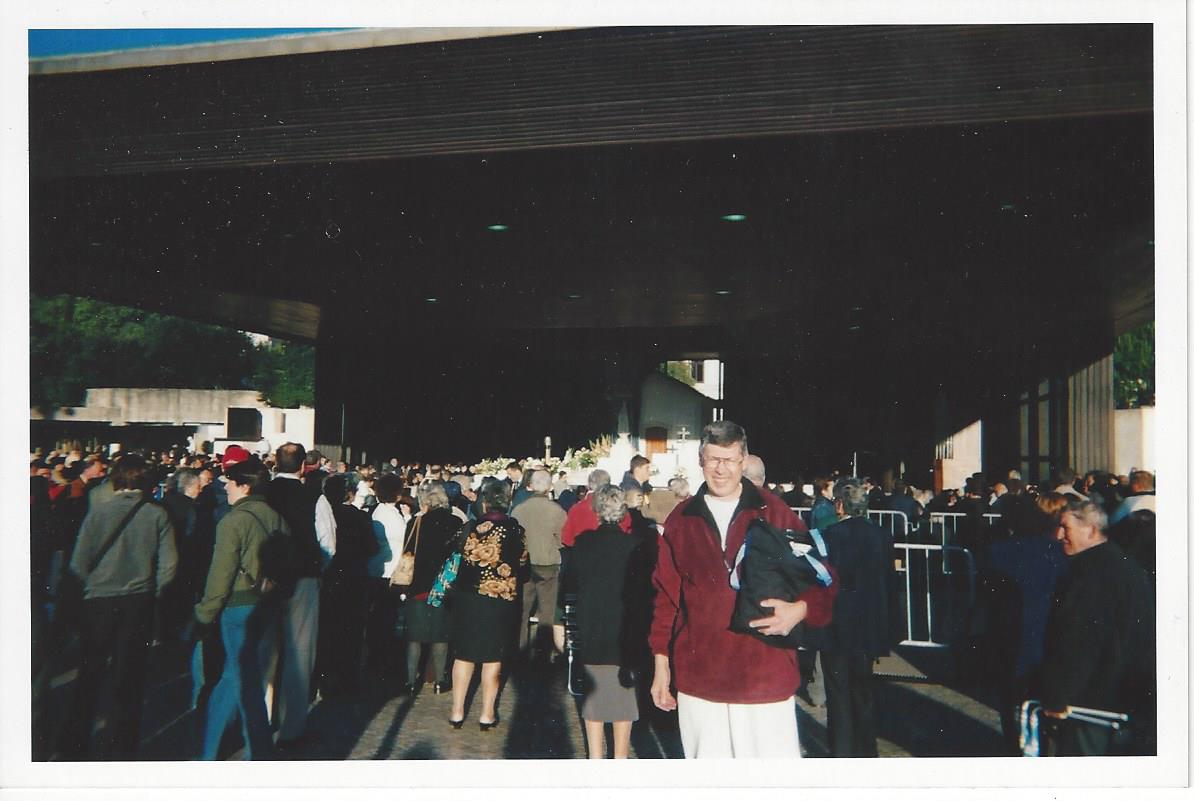
Tony McGinley in front of the Capelinha, Fatima, October 2004
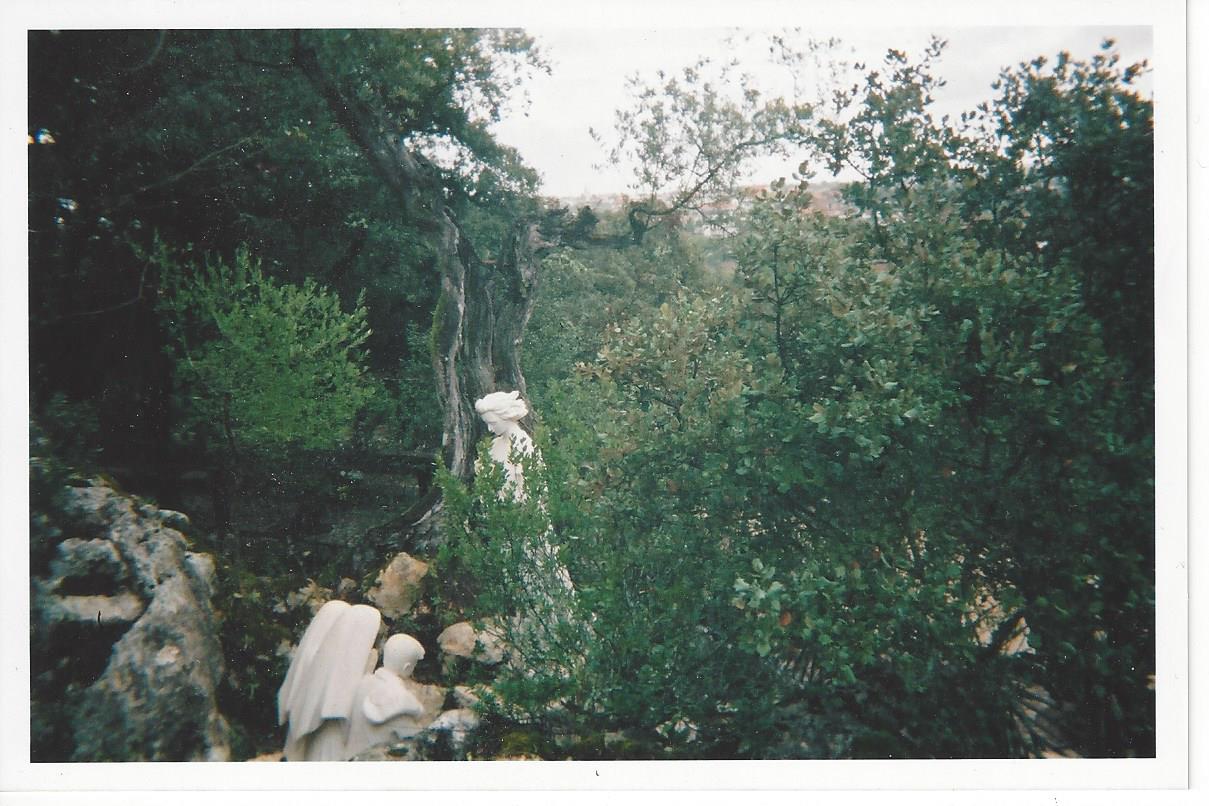
Site of one of the angelic visits of the three children, Lucia, Jacinta, and Francisco, October 2004.
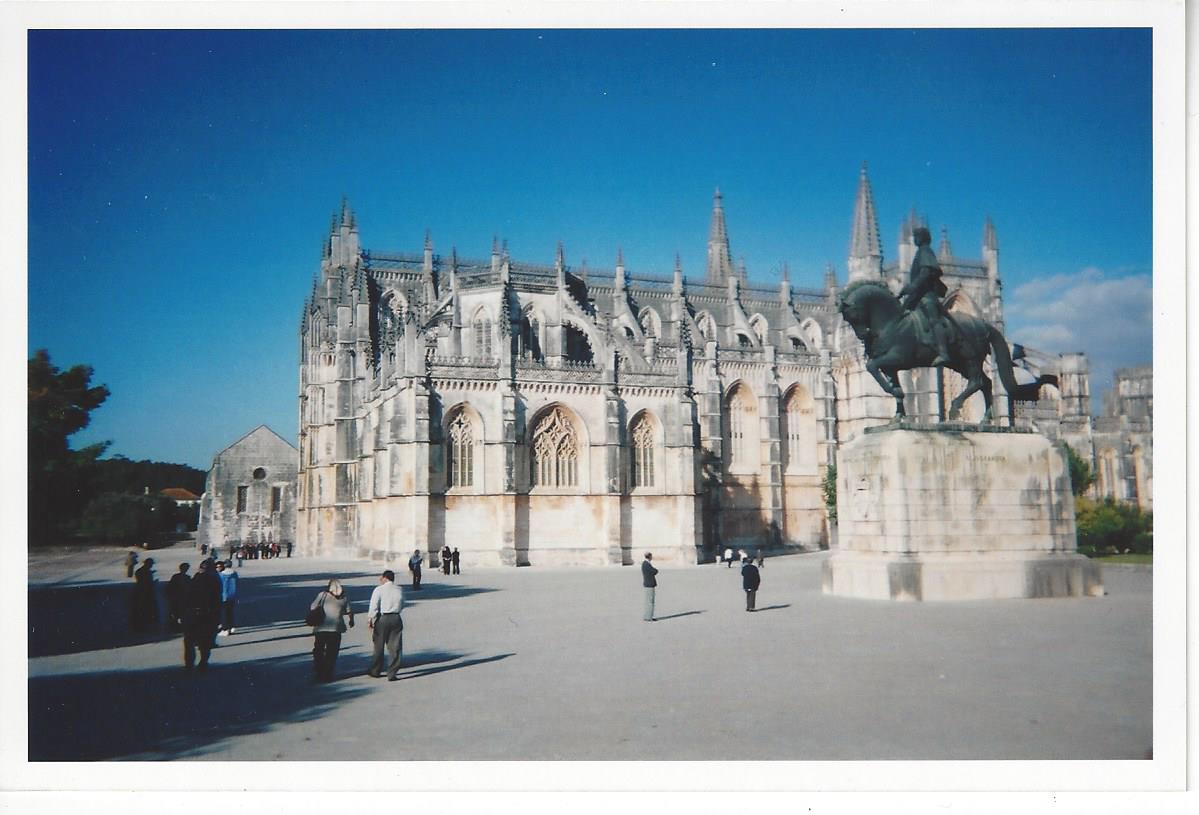
19th Century Domincan Monastery of Santa Maria de Victoria in Batalha, October 2004.
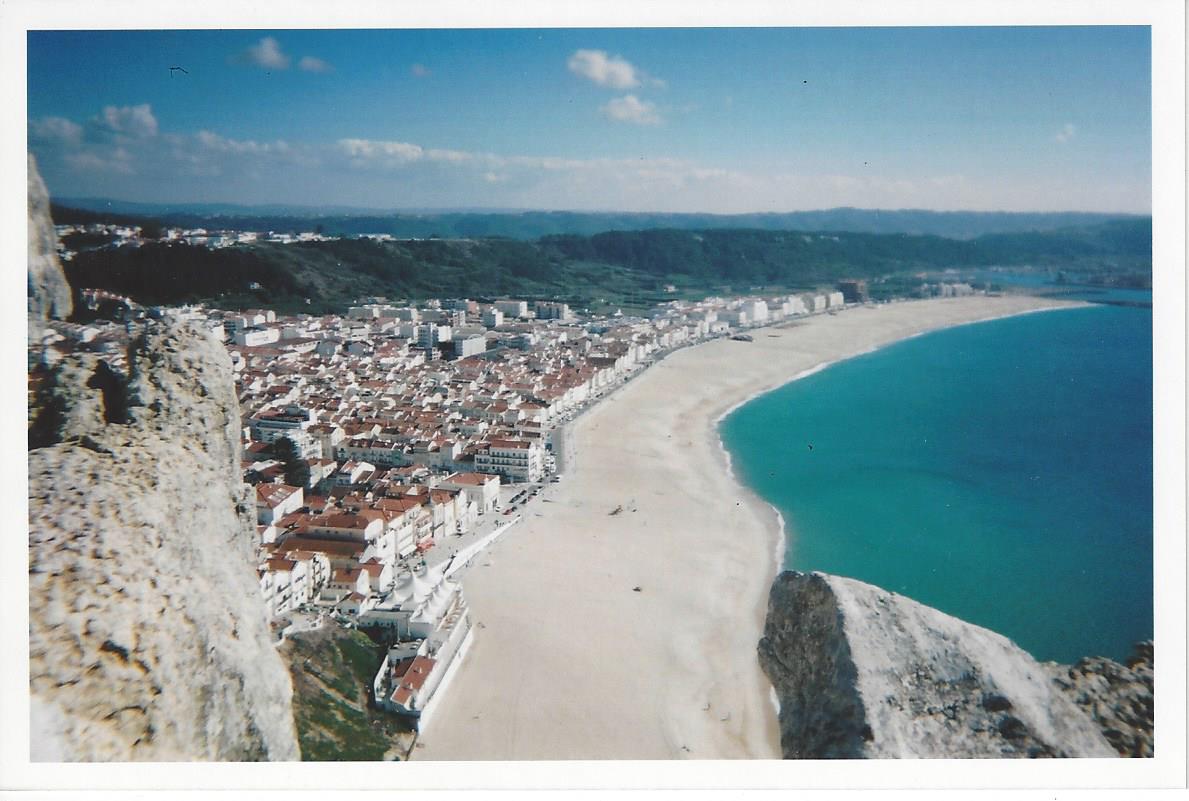
The seaside fishing village of Nazare, October 2004.
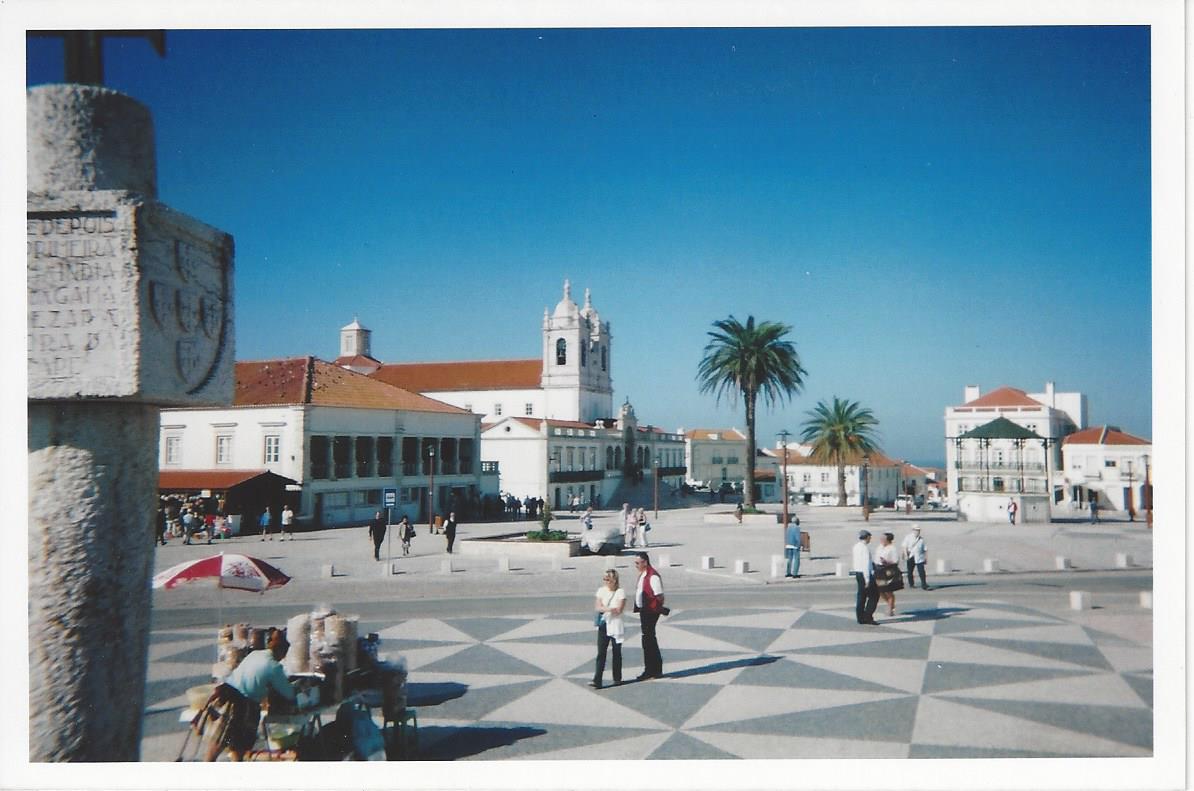
Some of the shops of the seaside fishing village of Nazare, October 2004.
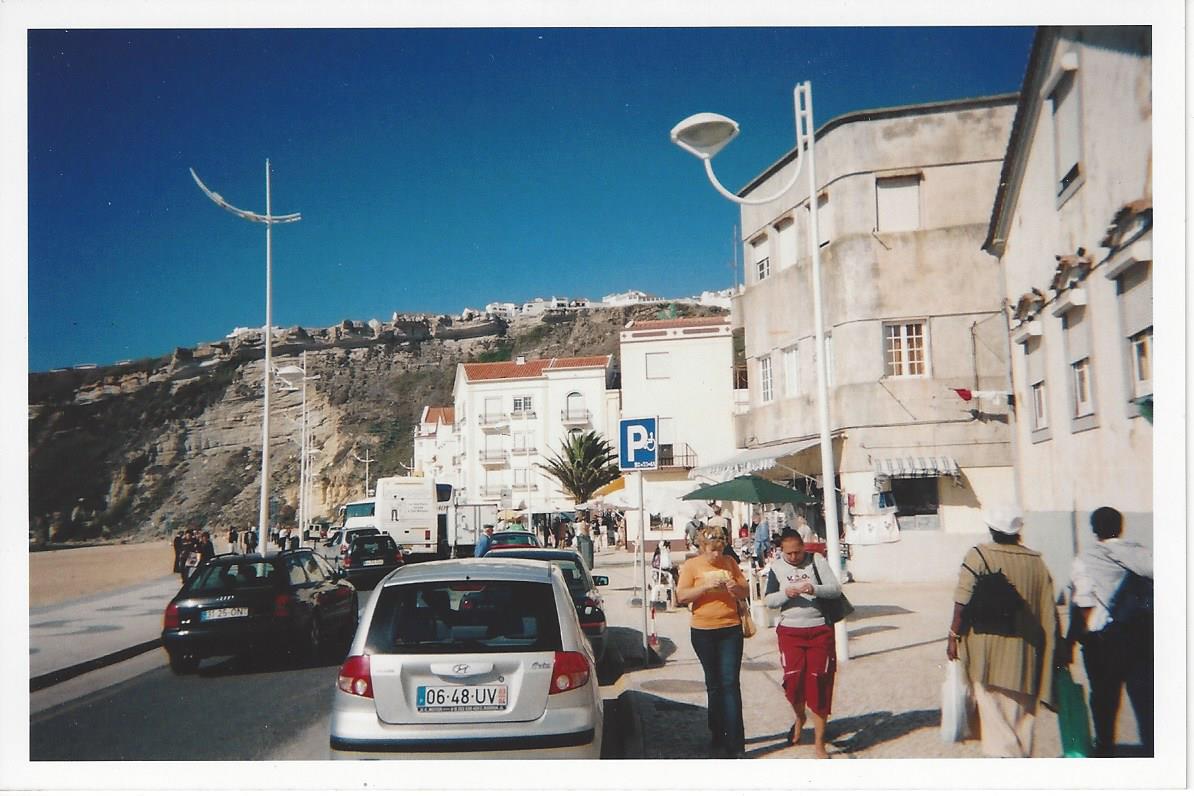
The cliffs of Nazare, October 2004.
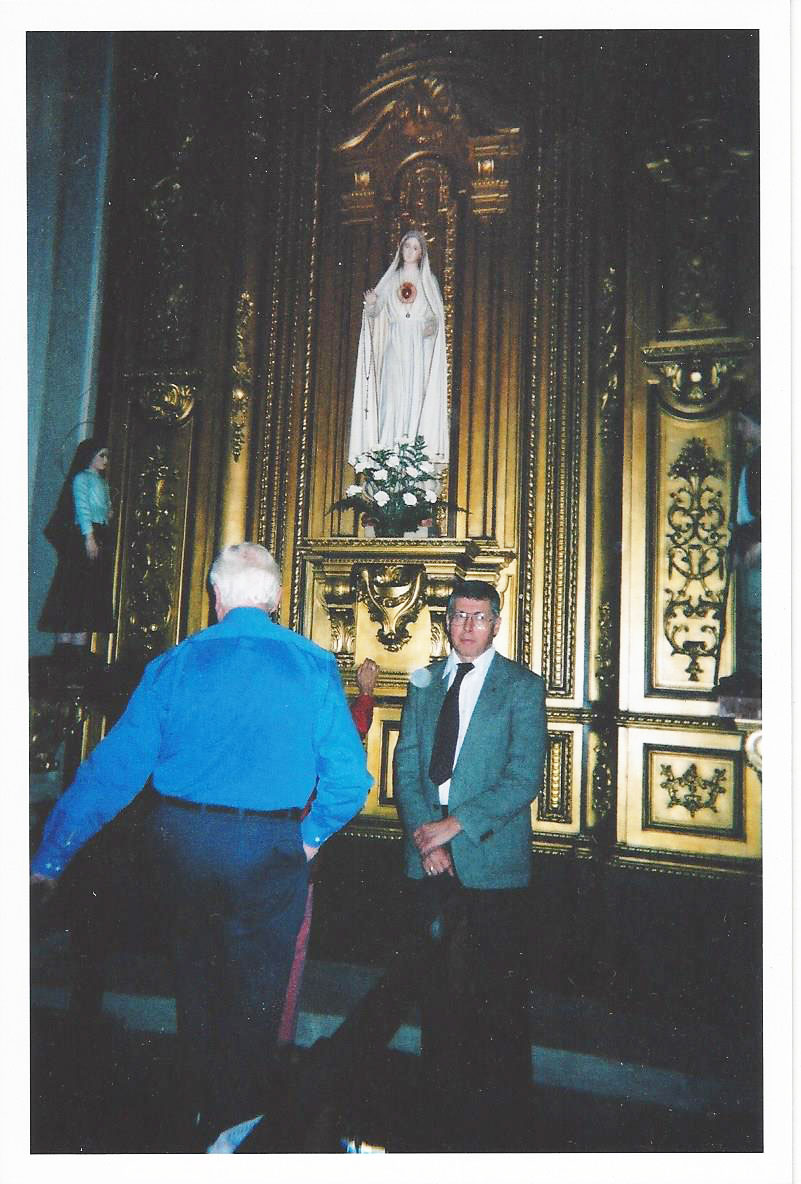
Tony McGinley inside the Carmela de Santa Teresa Monastery, October 2004.
BROADCASTS
FATIMA CHRONICLES
Autobiographical account of a visit to Fatima, Portugal
in October 2004 by our own Tony McGinley, Program Director of the OCFRP.
Click Here to print Fatima Chronicles
As trips go, five days did not seem to be enough time to experience Fatima. But at the end,
I was amazed at how much our small group of ten was able to accomplish on a Blue Army Pilgrimage
to FATIMA this past October 14 – 19, 2004.
From the moment we arrived at the Lisbon Airport at 6:00 A.M. on Sunday morning, Oct. 10, we were off to the races.
First, we took an early morning ride on our comfortable mini-bus through the historical areas
of downtown Lisbon. Our tour guide, Manuela, was most knowledgeable about all facets of
Portuguese society and culture, both past and present. She pointed out many of the historical,
architectural, and geographical features of downtown Lisbon such as the Tagus River running through
the heart of Lisbon out to the Atlantic Ocean and the historical monuments depicting many of
Portugal’s naval and maritime greats. Her expertise made me remember much I had learned about the
Age of Discovery (15th & 16th centuries) in school, and the great role played by Prince Henry, the
Navigator, and other notables of Portuguese history.
Next on the agenda was a Mass in the Cathedral of St. Anthony, also in Lisbon. The
architecture and art work was rich enough to make any student of medieval culture want to “go back
to the books.” By this time, we were tired, but onward we went, on to Santarem, the home of
the church containing the Eucharistic Miracle called “The Bleeding Host.”
Finally, at lunchtime, we arrived in Fatima and departed our bus at Domis Pacis – the Blue
Army hotel. After registration, a quick meal and a short rest, some of us made our way to the
Basilica and Capelinha (little Chapel), or Chapel of Apparitions where Our Blessed Mother
appeared to Lucia, Jacinta, and Francisco on the 13th of each month from May thru October of the
year 1917 (all except August 13).
What a thrill! I had always wanted to see this holy place ever since my Uncle Bob (d.o.b
10/13/1916) taught me about Fatima when I was just a boy. And finally, here I was – right where it all
happened. The area is quite large, measuring approximately 500′ by 900′ and can hold more than
100,000 pilgrims. But for me, the main focus was the chapel and the statue of Our Blessed Mother
marking her appearance on the five occasions mentioned above.
Before heading back to the hotel for dinner and a good night’s rest, I made a quick visit inside
the Basilica, and was able to see the grave markers for Jacinta and Francisco. It was fortunate that I
did so, since as it turned out, I did not get another chance for the remainder of the trip.
On the next morning, we went as a group back to the Sanctuary area where Manuela was able
to give us detailed information about such things as the art work in the Basilica. It was at this time,
we had hoped as a group to visit Jacinta and Francisco, but unfortunately, we were prohibited from
doing so on account of a Mass going on at the same time.
Monday afternoon, we made our way on the bus to Aljustrel and the Loca do Cabeco at
Valinhos to see the places where the children grew up and where the Angel of Peace appeared to
them on three occasions in 1916, and where Our Blessed Mother appeared to them in August of
1917. While each of us took away many impressions, I was probably most struck by the simplicity
of it all. Nothing complicated here. No television, radio or other modem conveniences. These
people were of humble origins and yet steeped in religious faith. It helped me get my own life and
ambitions in perspective. Who needs the rat race of keeping up with the Jones’s, I asked myself.
Just keep my focus on the things of God. This is what the children and their families were telling me.
Afterwards, we made our way back to the hotel for the climactic next two days – the 12th and 13th.
On the morning of the 12th, we made our way to Coimbra, just a little more than an hour’s ride
from Fatima. Along with numerous churches and palaces of artistic merit, Coimbra was and still
is a great university town steeped in medieval traditions which until 1911 was the only University in
Portugal. But we didn’t travel to this town of winding streets, and hills just to see these sites, but to
visit the Carmelo de Santa Teresa Monastery, the home of Sister Lucia herself, and to attend Mass.
(Now, one must remember that the 12th of October was my birthday, and I was determined to do all
I could, within reason to actually meet Sister Lucia, despite the fact that everyone said that it was
next to impossible).
The two priests on our trip, Father Charles from Brooklyn, NY and Father Robideau
from Lansing, Michigan concelebrated with two priests from Ireland, and together with the group from
Ireland, we attended Mass right in the same building where Sister Lucia, the little shepherd girl, now
a nun, was just yards away. The chapel was beautiful. It was decorated with beautiful religious
paintings along side of two statues depicting Jacinta and Francisco. What I did not notice at the time
was the enclosure high in the back where a choir loft would be. Later, I was told that Sister Lucia
often sits there as she watches Mass from above.
After Mass was over, we were permitted to take some pictures inside the chapel and then
before we knew it, we were outside and back on the bus to our next destination, Nazare, a seaside
fishing village, very picturesque and lined with a multitude of souvenir shops.
Before describing Nazare further, I have to tell you of my disappointment in Coimbra. Not
only did I not get an opportunity to meet Sister Lucia, but I also did not get enough time to reflect on
being in the same building with her. We were so attentive to the Mass and to the time we spent
taking pictures, we never got a chance to do some serious meditation. On the ride to Nazare, I
resolved that if I got the chance, I would come back to the convent and try again before we were to
depart for home, the day after next, the 14th.
As I was saying, if I was ever going to retire somewhere, Nazare would be at the top of the
list. The view from the cliffs above looking down below at the town and shoreline is nothing short of
spectacular. And the view was just as striking looking at the cliffs from the vantage of the town itself.
The seafood lunch was a meal I’ll always remember. What I thought to be a bowl of soup
from the menu turned out to be a seafood meal in a soup that was just downright delicious. The little
restaurant had the ambience of a seaside inn nestled in a cove off Nantucket Island. The ocean water
was as blue as the sky itself without a cloud, and the sun was out in force just like an Indian Summer
day in the Northeast.
I hated to leave, but back on the bus we went – on to Batalha- where the 19th century Dominican
Monastery of Santa Maria de Victoria (Our Lady of Victory) was located.
I have seen many churches, basilicas, cathedrals, and so on, over the years, but Our Lady of
Victory is almost in a class all by itself. Built over the course of several centuries, it exemplifies
several styles of architecture: the late Gothic, Romanesque, Manueline, Mudejar and Italian
Renaissance. As for the Gothic, the “flying buttresses” were stupendous and the Sculpture over the
entrances including the gargoyles were examples of the finest workmanship. It was in this Abbey
where many Portuguese greats including Prince Henry the Navigator, himself, were buried.
Calling it a day, Manuela got us back on the bus for the ride back to Fatima where we were to
rest up and have dinner in preparation for the big candlelight rosary procession followed by a
concelebrated Mass in the Sanctuary area.
By 5:00 P.M. we were back at the hotel. Rather than rest up, I used the time to walk with
some of my fellow pilgrims into downtown Fatima to pick up some souvenirs. By this time, the
streets were full of pilgrims in anticipation of the evening to come. We got back to the dining hall
just in time for dinner, after which we prepared to walk over to the Sanctuary as a group. Before that
was to happen, Leroy from Virginia, took me aside and asked me if I would carry the American
flag during the procession. My first reaction was to say no since I just did not feel worthy. But he
told me that we were short on manpower and that the group really needed my participation. So I
agreed and immediately I underwent this transformation from being just me to being the standard
bearer for the U.S.A. in this upcoming procession where there were to be thousands under the
spotlight of television cameras and high-powered lights.
Before I knew it, we were all assembled in the lobby, and off we went – the ten of us to
represent the U.S.A. As few as we were, we had become a close knit group and felt that we would
all be there for each other for moral support. Boy! Was I wrong. We were no sooner over there
when the marshal of the event singled me out from the others and led me to the front of the
procession alongside the flags of other nations. There I was – with a flag the size of the state of
Texas under the glare of television lights and under the scrutiny of thousands. I could feel all of those
eyes as well as those of the people watching their T.V. sets.
The rosary procession began at 9:00 P.M. and ended on the steps of the basilica
approximately an hour later when we then attended Mass. We stood with our flags throughout all of
this time, and afterwards, I was seriously tired. My fellow travelers rescued me after the Mass and
told me that I held the flag tall and straight, better than any of the other flag holders. I was most
proud. I felt that I was on an assignment, that I was America’s ambassador to Fatima, and I prayed
about it to Our Blessed Mother especially as we processed by the Capelinha. I prayed for our
country with all of its rights and wrongs; I prayed for world peace; I prayed for all of those souls
who were in jeopardy; and I prayed in reparation for offenses against the Immaculate Heart of Mary.
And finally I prayed for all of my friends, relatives and all of those most in need of prayers. What a
thrill, especially when you consider that I had no idea this was going to happen!
Once we got back to the hotel, we immediately retired for the evening in preparation for the
events of the next day – the 13th. But before I did, I checked with the hotel to find out about the bus
schedule to Coimbra. To my great joy, it was possible to get a second chance to visit the Carmela de
Santa Teresa Monastery right after the rosary procession and Mass to be held the next day at the
Cova beginning at 10:00 A.M. and ending about 1:00 P.M.
I was up early to get all of my gifts blessed at the Sanctuary before breakfast. It was pretty
chilly, but I stepped out quickly and arrived at the Cova hoping to find a priest who would help me.
Fortunately, I found a priest from Spain who understood my feeble attempts to communicate and
proceeded to bless everything not more than 20 yards from the Capelinha and the statue of Our
Blessed Mother.
I hurried back, ate breakfast, and joined the rest of our group for the events to be held that morning.
If you can picture the Sanctuary area in daytime just as I described the scene the night before,
then you have some idea of what things were like. Thousands and thousands, all gathered for another
gigantic rosary procession to be followed by a concelebrated Mass with scores of priests. It was a
bright sunny day and it reminded me of what the scene must have been like when the miracle of the
sun took place exactly 87 years before to the precise day and hour. Boy! Talk about historical
reenactments. The whole event was electrifying.
The sequence of events was as I said very similar to the night before except that this time
everything was in daytime, and at the conclusion, there was the farewell song to Our Lady of Fatima,
accompanied by a sea of waving handkerchiefs.
It was 1:00 P.M., and I immediately set out for the bus station approximately a half mile away in
order to go to Coimbra. My excitement was keen for I was about to go back to Sister Lucia’s convent
provided, of course, I could successfully find my way. There was no room for error. (Our flight back
home was on the next day). I got to the bus station only to see a mass of people returning home to
Coimbra and other parts of Portugal after coming to Fatima earlier in the morning to attend Mass at the Cova.
If you can picture a crowd of people trying to get on a subway train at rush hour in New
York City, that’s what I was up against along with the disadvantage of not being fluent in Portuguese.
In the interest of time and space, I’ll just tell you that I made it onto the bus, but only after suffering
much anxiety – caused not least of which by the fear that there were too many people on the bus and
that I would not be allowed to get on.
So there I was on the bus, trying to plan my next move once I arrived at the bus station in
Coimbra. I planned to take a taxi provided there was one to be found.
At approximately 3:00 P.M. the bus pulled into Coimbra, and once I got off, I immediately
went looking for a taxi. (talk about luck, or was it more than luck?) I not only found a taxi; but also
a nun who had the same idea as I did. Sister Rosaria was a Carmelite nun from Canada of all places
who spoke fluent Portuguese and was on leave to visit family in Portugal, and we shared the same
goal. If it were possible, we both hoped to see Sister Lucia! For the first time I really felt I had a
chance to accomplish the impossible. We agreed to share the taxi to the Monastery and proceeded to
drive through the streets of Coimbra on our way to St. Teresa. Once we arrived, Sister explained that
I should wait in the chapel, while she introduced herself to the Carmelite community and made her
request for a visit with Sister Lucia. All went according to plan, and after being introduced as a
pilgrim from America and on the recommendation of Sister Rosaria, I entered the chapel and got my
chance to sit, pray, and meditate on the fact that I was just yards away from Sister Lucia, once again.
After about an hour, Sister Rosaria came back for me, and I was immediately filled with a
great excitement. Had Sister Rosaria seen Sister Lucia? Or was she about to, and was she coming to
take me along? Well, dear friends, my heart was pumping excitedly while simultaneously I was
trying to maintain my composure.
I looked at Sister Rosaria and saw almost immediately that today would not be the day when
either she or I would get to meet Sister Lucia. To make a long story short, our timing was bad and it
just was not possible to see her at that particular moment.
Believe it or not, I took it well. I missed my chance to see her, but took solace in the fact that
I did get back to meditate again, and thanks to Sister Rosaria, I was reminded of the importance of
offering up our disappointments for the conversion of sinners and for promoting world peace.
In the course of our conversation on the trip back to Fatima (Sister Rosaria was also returning to
Fatima as well), we talked at great length about Fatima and a whole variety of topics which helped
to energize my faith greatly, But the one thing Sister Rosaria told me for which I will always be
thankful, she mentioned that Sister Lucia does read her mail and that I should write to her. At first, I
did not see much of a point, but upon reflection, I got more and more excited about the prospect of
communicating with Sister Lucia, if not in person, then by pen. I was reminded of the books I had
read and how various people had asked Sister Lucia to present their requests to Our Blessed Mother
on October 13, 1917. Up until now, I had always lamented the fact that I had not been there at the
time of Christ 2,000 years earlier and that I had not been present at Fatima in 1917 to make my own
requests. But now, I realized, I still had a chance. Sister Lucia remains in our midst and is still there
to be asked for help just as she was there in 1917.
I immediately started planning my letter once I got back home. What should I write about? I
pretty much figured out that I should write from the heart. Not only did I make requests both
personal and public i.e. world peace, but I also shared with her information about some of the
activities in which we had been promoting the message of Fatima back home in the Philadelphia area.
I also thanked her for being there for us in 1917 and for being there for us now in 2004!
In a way, I guess I can say that my trip has not ended because I am writing this account in
order to encourage you, the reader, to write Sister Lucia and to take advantage of her presence,
wisdom, holiness, and her special relationship to Our Blessed Mother. Speaking for myself, I think
that it’s a reasonable possibility that the Blessed Mother might just visit Sister Lucia again just as she
has on several occasions after 1917, and just as she did Jacinta after 1917 and before her death several
years later. With Sister Lucia praying for me, thanks to my letter, I figure my chances of spiritual
help are much improved. You can do the same.
Remember, write from the heart. Here is her address:
Irma Lucia (Lucia Santos)
Carmelo Santa Teresa
3000 Coimbra, Portugal
P.S. Her birthday is March 22, 2005 when she will be 98 years old. Wouldn’t it be a marvelous thing
for her to receive lots of birthday cards? Go for it!
Prepared by Anthony J McGinley
The Cova Da Iria, October 2004
Tony McGinley in front of the Capelinha, Fatima, October 2004
Site of one of the angelic visits of the three children, Lucia, Jacinta, and Francisco, October 2004.
19th Century Domincan Monastery of Santa Maria de Victoria in Batalha, October 2004.
The seaside fishing village of Nazare, October 2004.
Some of the shops of the seaside fishing village of Nazare, October 2004.
The cliffs of Nazare, October 2004.
Tony McGinley inside the Carmela de Santa Teresa Monastery, October 2004.

